On this page
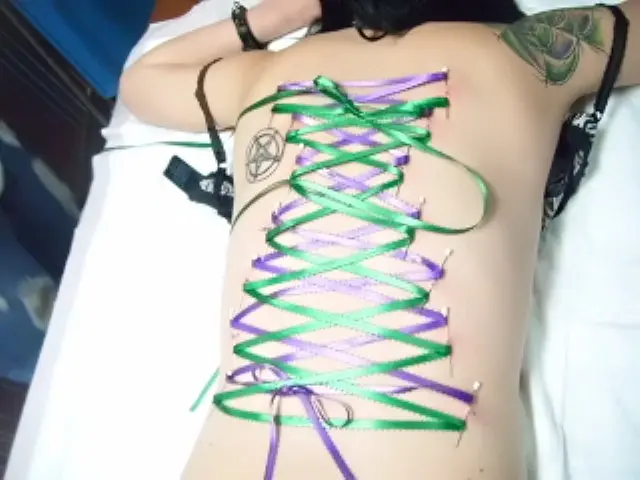
A corset piercing is two parallel rows of surface piercings, usually down the back, laced together with ribbon so the result resembles the back of a corset. A set is typically six to sixteen individual holes.
It is the most photographed piercing on this site and one of the least often kept. Understanding why is the whole point of this page.
Most are temporary, by design
The honest description of a corset piercing is temporary body art. The large majority are done for a photoshoot, a performance or an event, worn for a few hours, and taken out the same day or within a few days.
That is not a failure of the piercing. It is what it is usually for, and a piercer who tells you so is being straight with you rather than talking you out of it.
If you want one for an evening, that is a perfectly reasonable thing to book. Just go in knowing that is the arrangement, and knowing that you will still have small permanent marks afterwards.
Why a permanent set is so hard
Each hole is a surface piercing, with all the problems described in the surface piercing guide: nothing anchors it, and the body works it toward the surface over time.
A corset adds three things on top.
The ribbon pulls every hole at once. Lacing draws both rows toward the centre. That is a continuous sideways force on every single piercing, in the exact direction that produces migration. It is one reason permanent sets fail.
The back moves and is touched constantly. Chair backs, waistbands, bra bands, car seats, sleeping. There is no version of daily life in which a row of surface piercings down your back is left alone.
Failure is not all-or-nothing. Some holes migrate before others, which leaves a set that looks uneven long before it is gone. Deciding what to do with four remaining holes out of ten is a common and unsatisfying position to be in.
If you want a set that lasts
Some piercers will attempt one, and there are things that improve the odds:
- Surface bars rather than captive rings. A shaped surface bar sits far more stably than a ring, though it changes the look and makes lacing harder.
- Fewer holes. Six is a better bet than sixteen.
- Heavier gauge, 14 or 12, because a thin bar cuts through tissue more readily.
- Ribbon only for occasions. Wearing the lacing daily is the fastest route to migration. Leave the jewelry unlaced the rest of the time.
- Placement away from waistbands and bra bands, which is harder than it sounds on a back.
Even with all of that, plan in months rather than years, and expect to lose some.
Pain
About 3 out of 10 each. No individual piercing is severe; the skin of the back pinches easily and each needle passes quickly.
The experience is the accumulation. Twelve piercings in one session is a long sitting, and the skin becomes progressively more tender, so the last few are felt considerably more than the first. Many piercers will offer to split a large set over two appointments, which is worth accepting.
Healing
For a set intended to stay in, three months to a year, with a real chance that some holes never settle.
- Weeks 1-2: swelling and tenderness across the whole set, likely bruising.
- Weeks 2-12: crusting at every opening. This is a lot of aftercare, twice a day, in a place you cannot see.
- Months 3-12: slow maturing, with migration risk throughout.
Do not lace it during healing. Not once, not for a photograph. Every hole is an open wound and lacing pulls all of them.
Scarring
Assume permanent marks, and assume one for every hole.
A set removed the same day leaves small dots that fade but usually remain faintly visible. A set left in long enough to migrate leaves larger marks, and rejected surface piercings leave a line rather than a dot. On a twelve-piercing set, that is twelve marks in a symmetrical pattern down your back, which is itself fairly conspicuous.
This is the part that deserves genuine thought before booking, more than the pain or the cost.
Aftercare
Sterile saline twice a day at every opening, patted dry with clean paper towel. On a set of ten or more this is a real commitment, and you will need someone to help or a mirror arrangement, because you cannot see your own back.
- Sleep on your front or side, not on your back.
- Loose tops with nothing crossing the site.
- No pools, hot tubs or open water until healed.
- Photograph it monthly so you can spot migration you cannot see.
The aftercare guide has the underlying routine.
Watch for migration
More jewelry visible than there was, skin thinning over a bar, or openings widening into slits. On a set, check every hole rather than the ones that feel sore. See piercing rejection.
Removing a migrating hole early leaves a much smaller mark than letting it push out. On a decorative set, removing one hole usually means rethinking the whole arrangement, which is another reason to prefer smaller sets.
Cost
$150 to $400 for a set in a US studio, plus jewelry for each hole, depending on how many. Most studios price per piercing with a discount for a set. A temporary set for an event is usually cheaper because simpler jewelry is used.
Tip 15 to 20 percent, and bear in mind that a long session for a large set is real work.
Frequently asked questions
What is a corset piercing?
Two parallel rows of surface piercings, usually down the back, laced together with ribbon so they resemble the lacing of a corset. Each hole is an individual surface piercing, and a set is typically six to sixteen of them.
Are corset piercings permanent?
Very rarely. Most are done as temporary body art for a photoshoot or an event and removed within hours or days. Sets intended to stay in reject at a high rate, because each hole is a surface piercing and the ribbon pulls on all of them at once.
Do corset piercings hurt?
About 3 out of 10 each. No individual piercing is severe; the difficulty is sitting through eight or twelve of them in one session, and the skin becomes progressively more tender as it goes.
Do corset piercings scar?
Yes, and you should assume permanent marks. Even a temporary set leaves small dots, and a set left in long enough to migrate leaves larger marks. Multiply that by the number of holes.
Can corset piercings be left in permanently?
Some piercers will do a set with surface bars rather than rings, which improves the odds. Even then, expect rejection over months rather than years, and expect to lose some holes before others.
Should the ribbon be worn all the time?
No. Lacing pulls every hole toward the centre at once, which is the fastest way to make a set migrate. Ribbon is for the occasion; rings or bars alone the rest of the time, if the set is meant to last.
Sources
- Association of Professional Piercers - Suggested aftercare for body piercingshttps://safepiercing.org/aftercare/
- Association of Professional Piercers - Jewelry for initial piercingshttps://safepiercing.org/jewelry-for-initial-piercings/
- Association of Professional Piercers - Troubleshootinghttps://safepiercing.org/troubleshooting/
This article is for education only and is not medical advice. If a piercing is hot, swollen, spreading redness, oozing yellow or green discharge, or you have a fever, see a doctor today.